On this page11 sections
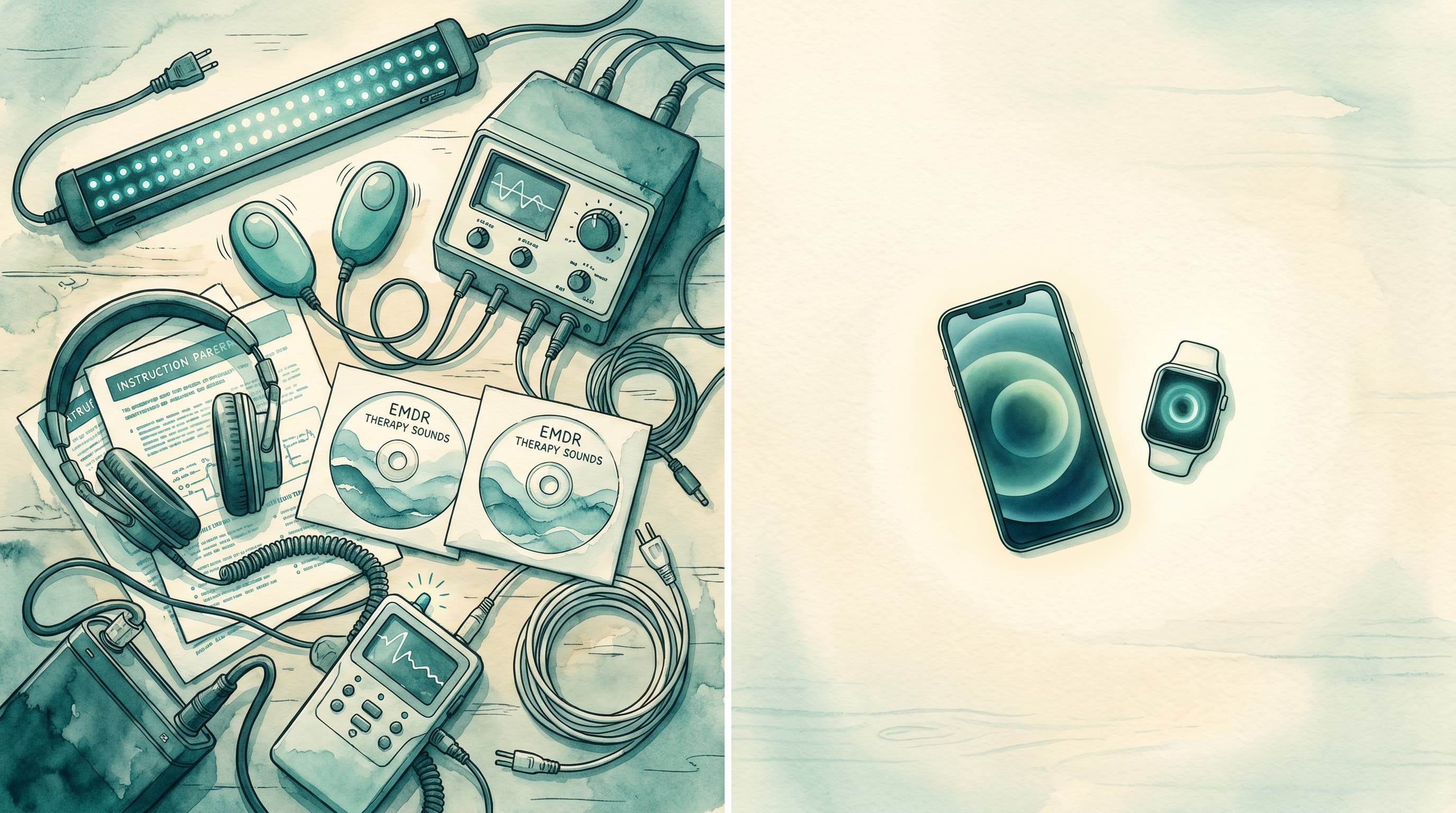
You may not. Buzzers, pulsers and tappers deliver alternating left-right input, and the phone in your pocket delivers the same input through its vibration motor, its screen and a pair of headphones. So the questions worth asking are about price, feel, setting and how the person receiving it connects, not about whether the hardware works. It does work, and it has for more than thirty years.
The naming makes shopping harder than it needs to be. Tappers, buzzers, pulsers, pulsators and paddles are largely the same product sold under different words.
Here is what each category is, what it verifiably costs, who still needs it, and what a phone or a watch covers at no cost.
Tappers, buzzers, pulsers, paddles: the same device under five names
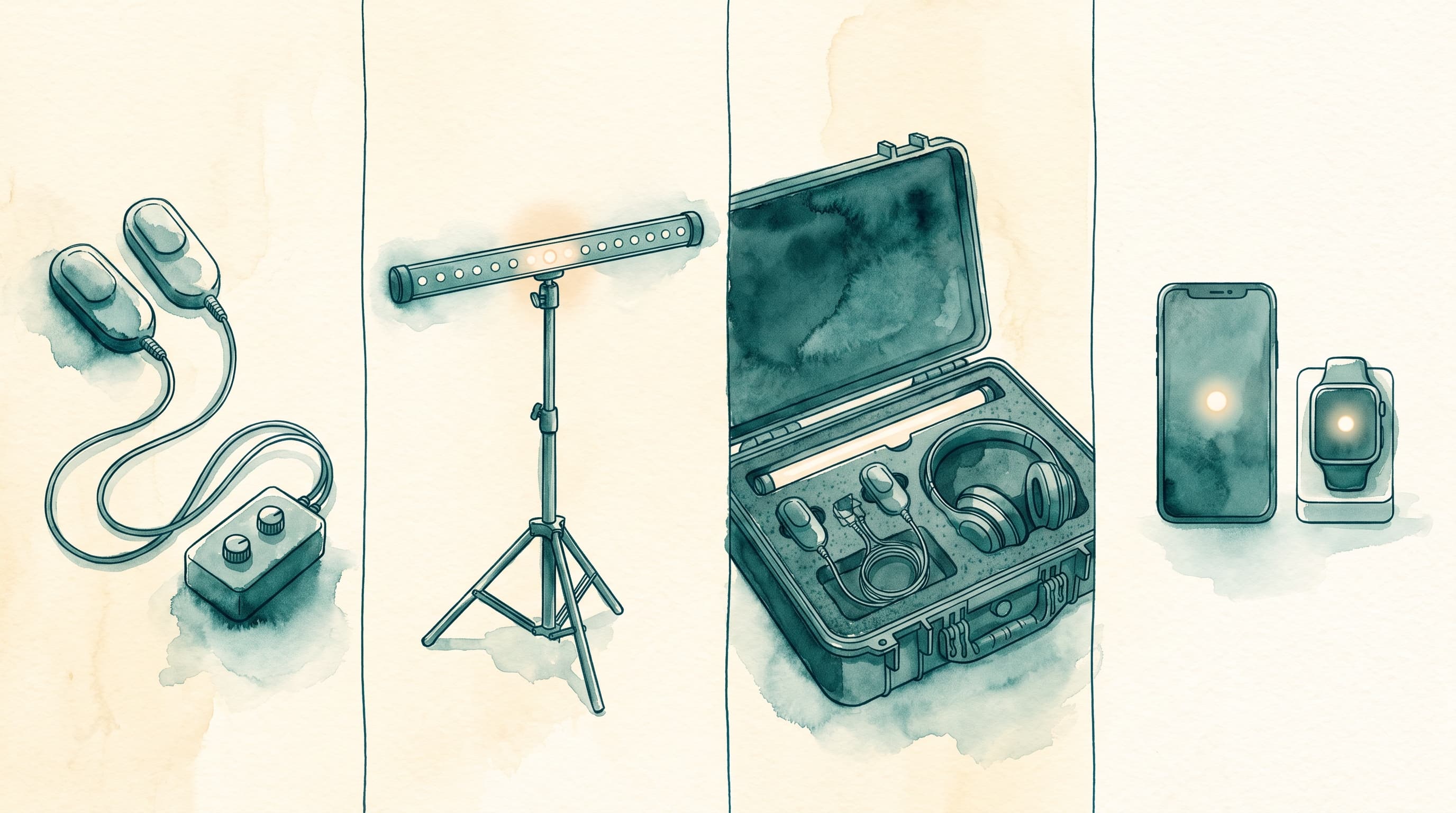
Bilateral stimulation, often shortened to BLS, is any alternating sensory input: left, right, left, right. Almost every handheld EMDR device on the market produces it the same way. Two small units, one in each hand, vibrate in turn at a speed someone sets.
Vendors name those units differently. NeuroTek sells pulsers, EMDR Kit sells pulsators, and other sellers use tappers, buzzers, hand tappers or paddles. The word tells you which catalog you are reading, not what the device does.
Two things do differ. One is what the unit connects to: a control box, a computer, or a phone. The other is who sets the speed: the person holding it, or a therapist somewhere else. Those two answers matter more than the name on the box. If you would like to learn how bilateral stimulation works, this article covers it in plain language.
Light bars are the one genuinely different category, because they deliver the visual form rather than the tactile one.
Handheld pulser sets
A pulser set is two vibrating units plus a controller. The controller sets speed and intensity, and the units alternate left and right while the client holds one in each hand or tucks them under their knees. Wired sets run a cable from each pod to the box. Wireless sets drop the cable and add a battery to charge.
NeuroTek Tac Kits run $149.99 to $369.99 depending on the bundle. EMDR Kit pulsator sets run $264 to $352. If you already own a controller and need pods on their own, NeuroTek sells those at $34.99 to $119.99.
What the money buys is a dedicated object. It is sturdy, it does one thing, and it never shows a notification mid-set.
What replaces it: a phone in each hand, or haptics on an Apple Watch, with the therapist setting the speed from their own device. In EMDR Tappers that sits in the free tier, so the replacement costs nothing.
Light bars
A light bar is a horizontal strip of LEDs on a stand or a desk mount. The light travels from one end to the other at an adjustable speed, and the client follows it with their eyes while keeping their head still. It is the most expensive of these categories.
NeuroTek EyeScan light bars run $399.99 to $799.99. EMDR Kit light tubes run $346.50 to $412.50.
What a light bar gives the eyes is a point of light moving from side to side along a fixed path at a steady speed. A screen gives them the same thing. Place a laptop, a desktop monitor or a tablet where you would place the bar, and a dot crossing the screen gives the eyes a wide path to follow. Research on why bilateral stimulation helps points to the steady back-and-forth movement and the attention it takes, not the device producing it: studies comparing eye movements with listening tasks find similar results.
A bar still earns its price in one situation. It sits at a fixed distance and needs no account and no connection.
What replaces it: a moving dot on a screen the client already has, at whatever speed, color and path you choose, with the therapist adjusting any of them mid-set from their own device. Visual bilateral stimulation in EMDR Tappers is free and needs no account at all, so the replacement costs nothing, and there is no stand to set up or carry between rooms.
Complete kits
A complete kit bundles the three forms into one purchase: a light bar or tube, a pair of pulsers and headphones for the audio channel. It is the buy-once option, and the price reflects that.
EMDR Kit complete kits run $522.50 to $588.50.
What replaces it: visual, audio and tactile in one app, switchable mid-session without swapping cables. EMDR Tappers has all three in the free tier, so the replacement costs nothing.
Wireless and platform-sold units
The newer tactile units are sold alongside a session platform rather than on their own. The platform runs the session, the hardware is sold to go with it, and the purchase usually moves from the practice to the client.
bilateralstimulation.io sells USB buzzers at $129. They plug into a computer, not into a phone or a tablet, so a client joining from their phone cannot use them. BilateralBase sells Tactile Tappers at $136, and they are not compatible with iPhone or iPad. Wevana sells Tabs at $249, wireless, with a free companion app.
Before buying here, check the detail that decides whether the unit gets used: what does it connect to, and does the client own that? A buzzer that needs a laptop does not help someone who joins from a phone. Our comparison of the best EMDR apps for therapists covers which platform each of these belongs to.
What replaces it: the client's own phone or Apple Watch, controlled by the therapist in real time over the connection the session already uses. That costs the client nothing.
Cheap EMDR tappers
Low-priced generic buzzers do exist. They turn up on general marketplaces and handmade-goods sites, often unbranded, and they do produce alternating vibration.
What you give up is therapist control. A generic buzzer runs on its own setting, so a therapist in another location cannot adjust it, which rules out remote sessions. We could not verify prices or specifications for these units, so none appear here.
The cheapest tactile option that keeps therapist control is the device the client already carries. One reviewer put it plainly: "EMDR equipment is expensive and this makes it accessible to clients."
What replaces it: the phone your client already carries, with the therapist setting the speed. Nothing to order and nothing to wait for.
What it all costs, side by side
Here is the whole category in one view. The bold figures are the verified hardware prices, and the last column is what the same input costs in the app.
| Shopping for | Hardware price, verified | With EMDR Tappers |
|---|---|---|
| Handheld pulser sets (tappers, buzzers, pulsators, paddles) | $149.99 to $369.99 NeuroTek Tac Kits; $264 to $352 EMDR Kit pulsator sets; pods alone $34.99 to $119.99 | Free. A phone in each hand, or Apple Watch haptics |
| Light bars (light tubes, EMDR machines) | $399.99 to $799.99 NeuroTek EyeScan; $346.50 to $412.50 EMDR Kit light tubes | Free, no account. A moving dot on any screen |
| Complete kits (light, tactile and audio bundles) | $522.50 to $588.50 EMDR Kit complete kits | Free. All three forms in one app |
| Platform-sold units (USB buzzers, tactile tappers, tabs) | $129 bilateralstimulation.io; $136 BilateralBase; $249 Wevana Tabs | Free. The client's own phone or Apple Watch |
| Cheap generic buzzers (unbranded marketplace tappers) | Not verified, so none listed | Free. Nothing to buy |
All prices were checked on the vendors' own websites in September 2026 and may change.
Who still needs hardware
Four situations make a purchase worth it.
- There is no reliable internet where you run sessions. In EMDR Tappers, visual and audio work offline once the app is installed, but tactile and any synced two-device session need a connection. A wired pulser set needs none.
- The handoff is part of your ritual. If passing a client two pulsers before a set is how you open the work, there is no digital version of that gesture.
- You already own equipment that works. Kit that is paid for and still running is not a reason to spend again.
- A particular feel matters. If you or a client prefer a dedicated pod in the palm to a phone, that preference is reason enough.
If one of those describes you, buying hardware is a sound decision, and nothing here is meant to talk you out of it. If none of them do, the purchase is paying for a delivery method you can already get for free. For the fuller version of that choice, see how physical and digital bilateral stimulation compare.
The no-hardware option
A phone already contains the three things those categories sell separately: a screen, sound for a pair of headphones and a vibration motor. An Apple Watch adds haptics on the wrist.
The EMDR Tappers app uses them. Visual, audio, and phone or Apple Watch vibration are all in the free tier. Visual and audio need no account at all, so a client can open the web app and start a set without signing up first. An account is needed only to connect a phone or Apple Watch for vibration, and registration is quick and free.
Two limits are worth knowing before you rely on it. Visual and audio work offline once the app is installed. Vibration and any synced two-device session need an internet connection.
There are native iOS and Android apps, a web app and an Apple Watch app. It runs alongside Zoom, Doxy or whatever platform you already use. Solo use works the same way, with you setting your own speed. For the session side, see how therapist-led sessions work.
Frequently asked questions
What are the differences between EMDR buzzers and tappers?
There is no reliable difference. Buzzers, tappers, pulsers, pulsators and paddles all describe small handheld units that vibrate alternately, one in the left hand and one in the right. The names come from vendor catalogs, not from any technical standard. What varies is what the unit connects to and whether a therapist can set the speed remotely.
Do EMDR tappers work?
EMDR tappers deliver the alternating left-right input the EMDR protocol calls for, so yes. Research on the working-memory account of why bilateral stimulation helps found visual and auditory dual tasks performing similarly, which points to the rhythm mattering more than the device producing it. The therapy around the tapper is what does the work.
What are the best EMDR tappers?
The best EMDR tappers are the ones that fit how you actually run sessions. Three questions decide it: does it need to work remotely, who sets the speed, and what does it plug into? Wired sets are simple and durable. Wireless and platform-sold units allow remote control but need the client to own them. A phone or Apple Watch works remotely, lets the therapist set the speed, and costs nothing if the client already owns one.
How much do EMDR buzzers cost?
EMDR buzzers cost from $34.99 for a single replacement pod to $369.99 for a full NeuroTek Tac Kit, with EMDR Kit pulsator sets at $264 to $352 and platform-sold units at $129, $136 and $249, as listed in September 2026. Low-priced generic buzzers sell for less, with no published specifications. A phone or Apple Watch covers the same tactile input for nothing.
Can a smartphone replace EMDR pulsers?
A smartphone can replace EMDR pulsers for the tactile input. Its vibration motor produces the same alternating sensation, and two devices, or a phone plus an Apple Watch, give a true left side and right side. In EMDR Tappers this is part of the free tier. Tactile is the one form that needs an account and a connection.
Do wireless EMDR tappers work over telehealth?
Wireless EMDR tappers work over telehealth only if the client owns them and owns whatever they connect to, which is why platform-sold units move the purchase to the client. The alternative is the client's own phone or Apple Watch, controlled by the therapist in real time. EMDR Tappers is HIPAA-compliant, and a Business Associate Agreement is included with every therapist account at no cost.
Is an EMDR light bar worth the price?
An EMDR light bar is worth it if you want a fixed, dedicated visual tool that needs no account and no connection. Across the ranges checked, light bars run $346.50 to $799.99. If what you need is a dot moving side to side at a speed you control, any screen does that, and visual bilateral stimulation in EMDR Tappers is free.
So, do you still need them?
For most therapist-led sessions and for solo use, no. A phone or an Apple Watch delivers the same alternating input, in all three forms, at no cost. If you have no reliable internet, a handoff ritual you want to keep, or equipment that already works, then yes, and that is a fair call rather than a compromise.
If you are deciding between hardware and an app, see how to use the phone you already own instead of buzzers or pulsers. You can also try it before you buy hardware: open the EMDR Tappers web app and run a set of visual or audio bilateral stimulation without signing up.
This article is for educational purposes. It is not medical advice. Clinical decisions about EMDR therapy and bilateral stimulation tools should be made by licensed therapists in the context of their practice. Hardware prices were checked on the vendors' own websites in September 2026 and may change.